
It’s the moment you’ve been looking forward to since your eyes opened this morning, you’re crawling into bed carefully to be sure you don’t wake your partner who’s already checked in to dreamland. You find your favorite sleeping position and close your eyes. You start to think about the day, the good, the bad, the forgotten and all of a sudden you’re wide awake. Then, the feelings start to flow; followed quickly by the questions. Primarily, how can I be so wired when I feel so exhausted?
You’ve been “on” for months. Maybe it’s a toddler who doesn’t sleep, a teen in a hard season, a parent who needs more help than they used to, or all three. You’re handling it. And yet you can’t calm down, and when you do you wake at 3 a.m., you forget lunch and then eat the whole sleeve of crackers at 4 while you’re getting those last emails off your plate before the kids storm through the door, and your energy feels like a phone that never fully charges.
If this sounds familiar, you aren’t failing at self-care. You’re in a long haul, and your body is keeping track. That’s not failure. It’s information.
Caregiving is a marathon, not a sprint
Caregiving can mean raising little ones, walking alongside someone you love, supporting a partner through illness, or helping an aging parent. Many of us in midlife are doing it in two directions at once.
Here’s the difference that matters: a hard week and a hard season are not the same thing to your body. Months without real recovery are different, and your body starts adapting in ways you can feel. Resilience isn’t about pushing harder. It’s about understanding your season and responding wisely.
What chronic stress does in the body
Your stress response is brilliant in a sprint. The cost comes when it rarely gets the signal that the sprint is over.
A small area deep in your brain, the amygdala, works like a home security system. When it senses a threat, it alerts the hypothalamus, your command center, and adrenaline and cortisol get you ready to act, often before your thinking brain catches up. The catch? Your alarm is fast but not great at sizing things up. A traffic jam or a tense family moment can set it off much like real danger, and in a caregiving season it may trip again and again in a single day.
Cortisol, one of your main stress hormones, normally follows a daily rhythm: higher in the morning to help you get going and lower at night so you can rest. Long-term stress is linked with changes to that rhythm, including a flatter or shifted daily pattern. Instead of dipping low overnight and rising toward morning, your stress system can stay more switched on into the evening and night, which may be part of why the 3 a.m. wake-up feels so familiar. Long-term caregiving stress has been linked with poorer sleep, changes in immune function, and lower well-being. Now, to most caregivers this may sound like the to-do list just got longer. This is not a post to worry you, or give you one more thing to do. It’s to remind you that your body has been gently nudging you as the fuel gauge ticks to empty.
It changes the picture: your body is responding normally to an abnormal load.
Where you feel it first: sleep, appetite, and energy
Sleep
Trouble falling asleep. The 2 or 3 a.m. wake-up. That “tired but wired” feeling at the end of a long day. Stress may keep your body’s alert system running when it should be winding down, and that can show up as lighter, more broken sleep. If sleep is the loudest signal for you, my post on Sleep and midlife energy walks through your two sleep systems and how to give them clearer signals.
Appetite
Stress can move appetite in either direction. Some caregivers forget to eat all day and look up at 3 p.m. realizing they’ve had coffee and a few bites off someone else’s plate. Others find themselves grazing on quick, energy-dense foods in the afternoon and evening. Both are common, and neither is a willpower problem.
Hyperfocus can serve as a distraction and delay true hunger until the appetite comes roaring back in the evening. Loading up energy in the evening may replete what was missed but also puts a big digestive load on your system as you head to sleep. Identifying quick, easy, convenient snacks to fuel your busy day is one of the simplest ways to prevent this backlash while giving you what you need and protecting sleep.
Energy
The afternoon crash. Caffeine creeping later into the day. Feeling flat even after a weekend. When irregular meals, short sleep, and constant alertness stack up, it makes sense that your energy feels unreliable. The body is well-prepared to recover from acute stress but when stressful episodes keep showing up like bad re-runs, our body and mind do not have time to recover. Good food choices, deep breathing and restful sleep are some of the strongest levers you can pull when your energy is depleted.
Try a simple load check
For one week, jot down each evening how you slept, when you ate, and one answer: How full did your day feel? Roomy, Busy, Packed, Overflowing. You’re not grading yourself. You’re looking for patterns, like lunch disappearing on the Overflowing days.
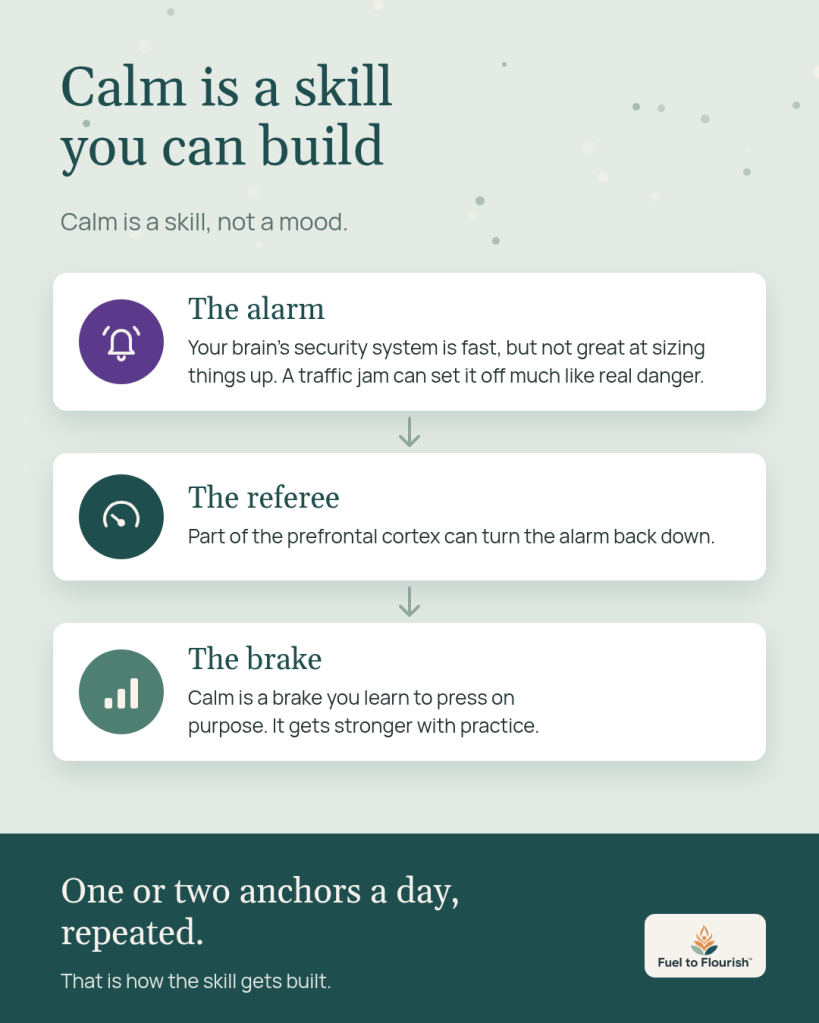
Calm is a skill you can build
Here’s the hopeful part. Your brain also has a referee! Part of the prefrontal cortex just behind your forehead can turn the alarm back down. Long stretches of stress make the referee’s job harder, which is one reason “just relax” rarely works when you’re running on empty. So think of calm as a skill, not a mood: a brake you learn to press on purpose, and one that gets stronger with practice. Predictable rhythms help your alarm settle, too. One or two anchors a day, repeated, is how that skill gets built.
What helps: one or two anchors a day
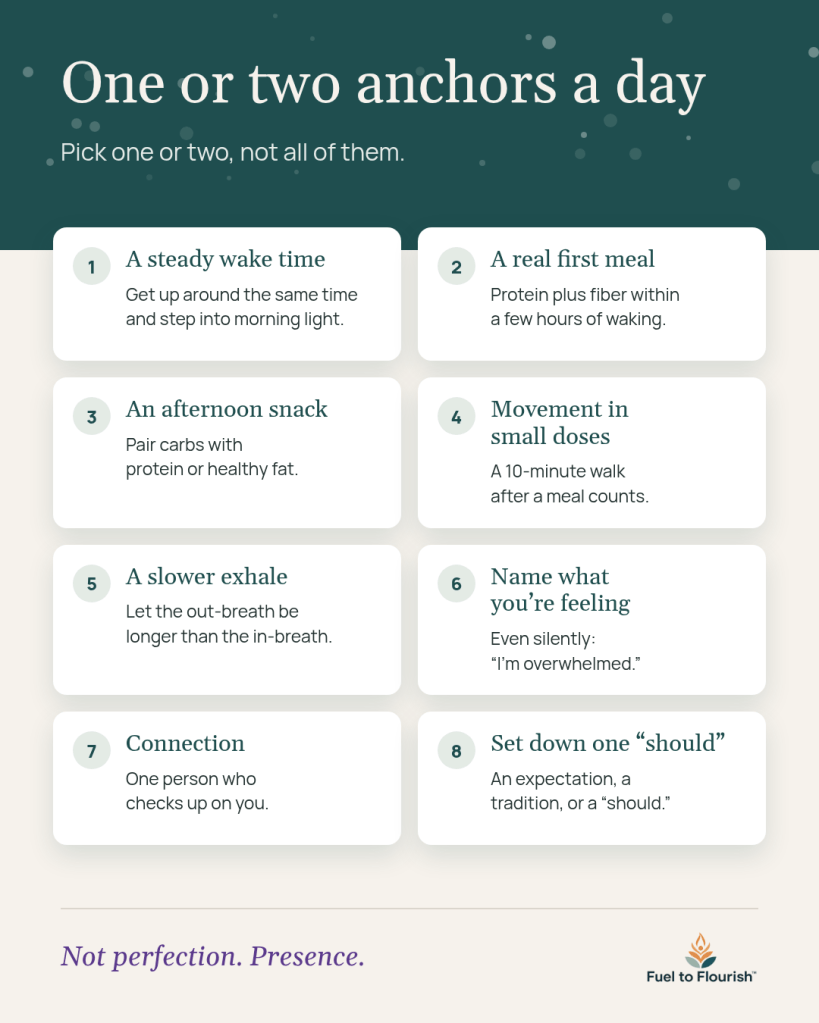
You may not be able to remove the caregiving load. But you can build scaffolding in your body to withstand the storm. Choose one or two anchors a day, not all of them.
- A steady wake time and morning light. Getting up around the same time and stepping outside within the first hour helps anchor your circadian rhythm. Bright morning light can also support your body’s natural morning cortisol rise, your built-in “get going” signal.
- A real first meal. Aim for protein plus fiber within a few hours of waking: eggs with whole-grain toast and fruit, or Greek yogurt with oats and berries. Protein helps you feel full, and this may help steady your energy so the 4 p.m. crash isn’t running the show. Breaking-the-fast with a well-composed meal can set a steadier cadence for your energy for the day ahead.
- An afternoon snack. When caregiving runs late, plan for it. Greek yogurt and fruit, hummus and whole-grain crackers, or a cheese stick and an apple. Keep it in your bag or car. Pairing carbs with protein or healthy fat builds a steady bridge to the next meal and keeps us from grazing in the kitchen or swinging by the coffee shop.
- Movement in small doses. A 10-minute walk after a meal or between appointments counts. Short bouts of light walking, especially after you eat, can also help soften the rise in blood sugar that follows a meal.
- A slower exhale. Before a hard conversation or a hand-off, take a few breaths where the out-breath is longer than the in-breath. Slower breathing may help calm the stress response. In my holiday kit for parents, I wrote, “Your slow breath is the first thing your child borrows.” The same is true for anyone you care for. Your nervous system is contagious in the best way, too.
- Name what you’re feeling. When the alarm goes off, put it into words, even silently: “I’m overwhelmed.” In a brain imaging study, naming feelings quieted the amygdala’s response.
- Connection as a health habit. I wrote more about this last week in Connection is a health habit. Support from someone close can even soften your cortisol response to stress. Find that person that you can let it all go with. You don’t need a team, just one person that checks up on you.
- Set down one “should.” Ask yourself: What can you set down this season? An expectation, a tradition, or a “should.” Giving ourselves permission is the first step to self-care. Helping can hurt.
| Caring for little ones this season? |
|---|
| Next Thursday, I’m sharing a free printable for families: Steady Through the Season, a holiday CALM mini-kit with calm-down cards for kids and a quiet page just for you. It will arrive first on my Bump to Baby(ies) blog. Subscribe there to get it in your inbox: bump2babies.blog |
When it’s more than a long haul
The ideas in this post are for everyday stress. Some signs deserve a conversation with your own doctor or a licensed professional:
- Trouble sleeping most nights for weeks at a time
- Low mood most days
- Losing interest in things you usually enjoy
- A big change in appetite or weight you didn’t intend
- Leaning on alcohol to wind down
If things feel like more than everyday stress, you deserve support, and reaching out is a strong thing to do. In the US, you can call or text 988, or chat at 988lifeline.org, to reach the 988 Suicide & Crisis Lifeline. If you or someone else is in immediate danger, call 911.
Steady is enough
You don’t need a perfect routine to get through a long season. You need a few anchors you can keep.
Not perfection. Presence.
Want support with your own plan? For one-on-one help with eating, sleep, and energy through a long season, you can work with me through Nourish. Request a visit with me on Nourish
There’s a second half to this conversation. Over on my Bump to Baby(ies) blog, I write for parents about the everyday side of steady: CALM tools, family rhythms, and real stories from raising five kids at once. This Thursday’s post, Healthy through the holidays, puts today’s ideas into practice for families, along with the free kit. Subscribe to Bump to Baby(ies)
Sources (24)
- Harvard Health Publishing. Understanding the stress response. Harvard Medical School. Updated April 3, 2024. https://www.health.harvard.edu/staying-healthy/understanding-the-stress-response
- Miller GE, Chen E, Zhou ES. If it goes up, must it come down? Chronic stress and the hypothalamic-pituitary-adrenocortical axis in humans. Psychological Bulletin. 2007;133(1):25-45. doi:10.1037/0033-2909.133.1.25. https://pubmed.ncbi.nlm.nih.gov/17201569/
- Adam EK, Quinn ME, Tavernier R, McQuillan MT, Dahlke KA, Gilbert KE. Diurnal cortisol slopes and mental and physical health outcomes: a systematic review and meta-analysis. Psychoneuroendocrinology. 2017;83:25-41. doi:10.1016/j.psyneuen.2017.05.018. https://pmc.ncbi.nlm.nih.gov/articles/PMC5568897/
- Vgontzas AN, Bixler EO, Lin HM, et al. Chronic insomnia is associated with nyctohemeral activation of the hypothalamic-pituitary-adrenal axis: clinical implications. Journal of Clinical Endocrinology and Metabolism. 2001;86(8):3787-3794. doi:10.1210/jcem.86.8.7778. https://pubmed.ncbi.nlm.nih.gov/11502812/
- Gao C, Chapagain NY, Scullin MK. Sleep duration and sleep quality in caregivers of patients with dementia: a systematic review and meta-analysis. JAMA Network Open. 2019;2(8):e199891. doi:10.1001/jamanetworkopen.2019.9891. https://pmc.ncbi.nlm.nih.gov/articles/PMC6714015/
- Kiecolt-Glaser JK, Marucha PT, Malarkey WB, Mercado AM, Glaser R. Slowing of wound healing by psychological stress. Lancet. 1995;346(8984):1194-1196. doi:10.1016/s0140-6736(95)92899-5. https://pubmed.ncbi.nlm.nih.gov/7475659/
- Pinquart M, Sörensen S. Differences between caregivers and noncaregivers in psychological health and physical health: a meta-analysis. Psychology and Aging. 2003;18(2):250-267. doi:10.1037/0882-7974.18.2.250. https://pubmed.ncbi.nlm.nih.gov/12825775/
- Kalmbach DA, Anderson JR, Drake CL. The impact of stress on sleep: pathogenic sleep reactivity as a vulnerability to insomnia and circadian disorders. Journal of Sleep Research. 2018;27(6):e12710. doi:10.1111/jsr.12710. https://pmc.ncbi.nlm.nih.gov/articles/PMC7045300/
- Torres SJ, Nowson CA. Relationship between stress, eating behavior, and obesity. Nutrition. 2007;23(11-12):887-894. doi:10.1016/j.nut.2007.08.008. https://pubmed.ncbi.nlm.nih.gov/17869482/
- Epel E, Lapidus R, McEwen B, Brownell K. Stress may add bite to appetite in women: a laboratory study of stress-induced cortisol and eating behavior. Psychoneuroendocrinology. 2001;26(1):37-49. doi:10.1016/s0306-4530(00)00035-4. https://pubmed.ncbi.nlm.nih.gov/11070333/
- Crispim CA, Zimberg IZ, dos Reis BG, Diniz RM, Tufik S, de Mello MT. Relationship between food intake and sleep pattern in healthy individuals. Journal of Clinical Sleep Medicine. 2011;7(6):659-664. doi:10.5664/jcsm.1476. https://pmc.ncbi.nlm.nih.gov/articles/PMC3227713/
- Motzkin JC, Philippi CL, Wolf RC, Baskaya MK, Koenigs M. Ventromedial prefrontal cortex is critical for the regulation of amygdala activity in humans. Biological Psychiatry. 2015;77(3):276-284. doi:10.1016/j.biopsych.2014.02.014. https://pmc.ncbi.nlm.nih.gov/articles/PMC4145052/
- Arnsten AF. Stress signalling pathways that impair prefrontal cortex structure and function. Nature Reviews Neuroscience. 2009;10(6):410-422. doi:10.1038/nrn2648. https://pmc.ncbi.nlm.nih.gov/articles/PMC2907136/
- Grupe DW, Nitschke JB. Uncertainty and anticipation in anxiety: an integrated neurobiological and psychological perspective. Nature Reviews Neuroscience. 2013;14(7):488-501. doi:10.1038/nrn3524. https://pmc.ncbi.nlm.nih.gov/articles/PMC4276319/
- Blume C, Garbazza C, Spitschan M. Effects of light on human circadian rhythms, sleep and mood. Somnologie. 2019;23(3):147-156. doi:10.1007/s11818-019-00215-x. https://pmc.ncbi.nlm.nih.gov/articles/PMC6751071/
- Leproult R, Colecchia EF, L’Hermite-Balériaux M, Van Cauter E. Transition from dim to bright light in the morning induces an immediate elevation of cortisol levels. Journal of Clinical Endocrinology and Metabolism. 2001;86(1):151-157. doi:10.1210/jcem.86.1.7102. https://pubmed.ncbi.nlm.nih.gov/11231993/
- Leidy HJ, Clifton PM, Astrup A, et al. The role of protein in weight loss and maintenance. American Journal of Clinical Nutrition. 2015;101(6):1320S-1329S. doi:10.3945/ajcn.114.084038. https://pubmed.ncbi.nlm.nih.gov/25926512/
- Buffey AJ, Herring MP, Langley CK, Donnelly AE, Carson BP. The acute effects of interrupting prolonged sitting time in adults with standing and light-intensity walking on biomarkers of cardiometabolic health in adults: a systematic review and meta-analysis. Sports Medicine. 2022;52(8):1765-1787. doi:10.1007/s40279-022-01649-4. https://pmc.ncbi.nlm.nih.gov/articles/PMC9325803/
- Zaccaro A, Piarulli A, Laurino M, et al. How breath-control can change your life: a systematic review on psycho-physiological correlates of slow breathing. Frontiers in Human Neuroscience. 2018;12:353. doi:10.3389/fnhum.2018.00353. https://pmc.ncbi.nlm.nih.gov/articles/PMC6137615/
- Balban MY, Neri E, Kogon MM, et al. Brief structured respiration practices enhance mood and reduce physiological arousal. Cell Reports Medicine. 2023;4(1):100895. doi:10.1016/j.xcrm.2022.100895. https://pmc.ncbi.nlm.nih.gov/articles/PMC9873947/
- Lieberman MD, Eisenberger NI, Crockett MJ, Tom SM, Pfeifer JH, Way BM. Putting feelings into words: affect labeling disrupts amygdala activity in response to affective stimuli. Psychological Science. 2007;18(5):421-428. doi:10.1111/j.1467-9280.2007.01916.x. https://pubmed.ncbi.nlm.nih.gov/17576282/
- Heinrichs M, Baumgartner T, Kirschbaum C, Ehlert U. Social support and oxytocin interact to suppress cortisol and subjective responses to psychosocial stress. Biological Psychiatry. 2003;54(12):1389-1398. doi:10.1016/s0006-3223(03)00465-7. https://pubmed.ncbi.nlm.nih.gov/14675803/
- National Institute of Mental Health. Depression. https://www.nimh.nih.gov/health/publications/depression
- 988 Suicide & Crisis Lifeline. https://988lifeline.org/

