

If your gut were a theater, it would have a cast of trillions. Most of them never get a curtain call. Today, six of them do.
Probiotic labels can read like a playbill printed in a language nobody taught us. So let’s meet the cast properly: who they are, where they hang out, what their superpower is, and (my favorite part) what the science actually says.
One backstage note before the show. A species name is the acting family. The strain is the actor. That string of letters and numbers after the name, like L. plantarum 299v, matters, because benefits belong to specific strains, at specific doses, in the specific people who were studied. Two strains of the same species can perform very differently.
Act I: The Resilient Spore-Formers
These performers travel in armor. Spores can ride out stomach acid and wake up further down the line.
Bacillus coagulans: The Resilient Guard
AKA Weizmannia coagulans

- Role: The tough one who survives the commute.
- Where you’ll find them: Mostly in supplements and some foods with added cultures.
- Superpower: Spore armor. In a lab model of human digestion, about 97% of spores of one strain (GBI-30, 6086) survived the stomach, and about half made it through the upper gut and germinated.
- What the science actually says:
- 7 trials in IBS found improvements in abdominal pain, bloating, and gas.
- Protein bonus when taken with 25 g of milk protein (like whey) for two weeks raised peak blood levels of several amino acids.
- Lactic acid and antimicrobial compounds (like coagulin) look promising in lab studies; we have less proof of what they do inside people.
Act II: The Transient Lactic Acid Bacteria
These are the touring performers. They usually pass through rather than move in, but they can make a real impression while they’re in town.
Lactiplantibacillus plantarum: The Barrier Builder
Formerly Lactobacillus plantarum

- Role: The stagehand reinforcing the set walls.
- Where you’ll find them: Kimchi, sauerkraut, and other fermented vegetables.
- Superpower: Supporting the “seals” between gut-lining cells. In 7 healthy volunteers, one strain (WCFS1) delivered directly into the small intestine increased tight-junction proteins near the cell borders within hours.
- What the science actually says:
- In a 4-week trial of 214 adults with IBS, strain 299v cut abdominal pain severity by about 45% (vs. about 23% with placebo), and bloating improved more than with placebo too. About 78% rated the effect good or excellent, compared with 8% on placebo.
- A note on “leaky gut”: increased intestinal permeability is real and measurable, but it isn’t a stand-alone diagnosis, and simply tightening the barrier hasn’t yet been shown to fix symptoms. I’d call this one “supports the gut barrier,” not “cures leaky gut.”
- Antioxidant and anti-inflammatory effects are mostly seen in the lab so far.
Pediococcus acidilactici: The Specialized Defender

- Role: Food-safety security detail.
- Where you’ll find them: Fermented foods such as fermented sausages, some cheeses, and sourdough starters.
- Superpower: Pediocin, a heat-stable antimicrobial protein that is especially good at stopping Listeria. Food scientists use pediocin-producing strains to help keep fermented foods safe.
- What the science actually says:
- The heavy-metal headline comes from one real human trial: 152 metal-industry workers ate yogurt with strain GR-1 or regular yogurt for 12 weeks. Blood copper fell about 34% and nickel about 38% with GR-1, vs. about 16% and 28% with regular yogurt.
- That’s one strain, one highly exposed group, one study. It is not a “detox” for everyday life, and it never replaces reducing exposure at the source.
Act III: The Resident Colonizers
These are the regulars with their names on the dressing room doors. It’s important to note that even residents, when taken as supplements, often visit rather than move in, and how long they stay depends on the person.
Bifidobacterium longum: The Multitasker

- Role: The cast member who talks to everyone, including the brain.
- Where you’ll find them: The colon, plus some yogurts and kefirs with added cultures.
- Superpower: Fermenting carbohydrates into acetate, a short-chain fatty acid (SCFA). In mice, acetate from protective bifidobacteria strengthened the colon lining and protected against a dangerous E. coli strain.
- What the science actually says:
- Gut-brain research is exciting and very strain specific. Strain 1714 lowered cortisol output and reported stress in 22 healthy men over 4 weeks.
- Strain NCC3001 improved depression scores in 14 of 22 adults with IBS (vs. 7 of 22 on placebo) over 6 weeks. Anxiety scores didn’t change significantly.
- These are small pilot studies. Promising, not a substitute for mental health care.
Bifidobacterium breve: The Gentle Protector

- Role: The calm, steady presence from day one.
- Where you’ll find them: One of the bifidobacteria commonly found in breastfed babies, and still part of the adult colon crew.
- Superpower: Carbohydrate metabolism and short-chain fatty acid production.
- What the science actually says:
- Strain B-3 (20 billion CFU daily for 12 weeks) lowered body fat mass and body fat percentage compared with placebo in 80 adults with BMI 25 to 30.
- Blood sugar data are early. In a 12-week pilot of 40 adults with type 2 diabetes, a B. breve supplement kept A1C lower than placebo; the authors themselves call it preliminary.
Akkermansia muciniphila: The Lining Keeper

- Role: Keeper of the mucus layer, the protective gel coating your gut lining.
- Where you’ll find them: Living right in that mucus layer, where it feeds on mucin. It is a homegrown resident you feed, more than one you buy in a jar of sauerkraut.
- Superpower: Tending the gut’s front line. Lower levels have been linked with obesity, type 2 diabetes, fatty liver, and inflammation (links, not proof of cause).
- What the science actually says:
- The pasteurized (heat-treated) form improved insulin sensitivity by about 29% and lowered insulin by about 34% and total cholesterol by about 9% vs. placebo in a small study of adults with obesity.
- It is still the newest cast member in supplements, and long-term data are limited but results are promising.
- In 20 healthy adults taking pomegranate extract, people whose microbes made the metabolite urolithin A had far more Akkermansia. Cranberry and grape polyphenols boosted Akkermansia in mice. Early evidence, but a delicious combo of polyphenols and probiotics.
How to Bring the Cast Home
Food first, always. Think of fermented foods as inviting the touring cast, and fiber as catering for the residents.
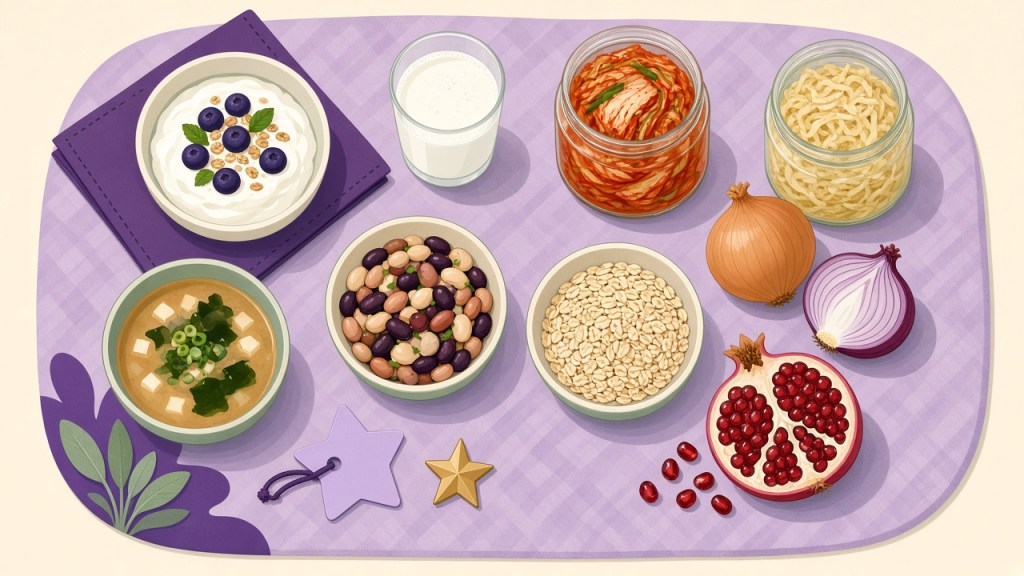
- Add a fermented food most days [Probiotics]: plain yogurt or kefir with live and active cultures, refrigerated sauerkraut or kimchi, miso, or fermented pickles in brine. In a 10-week Stanford study, adults who steadily added fermented foods had more diverse gut microbes and lower inflammatory markers.
- Feed the residents with fiber [Prebiotics]: beans, lentils, oats, barley, onions, garlic, leeks, asparagus, and slightly green bananas.
- Eat your polyphenol colors: pomegranate, cranberries, grapes, and other deeply colored produce.
- Go low and slow: if fiber or fermented foods make you gassy, build up gradually over a few weeks. The end goal is 25-35g of fiber daily.
- Thinking about a supplement? Look for the full strain name on the label, match the strain to the goal it was actually studied for, and use the studied dose.
- Check in first: talk with your clinician or dietitian before starting probiotics, especially if you are immunocompromised, seriously ill, pregnant, or breastfeeding.
The Bottom Line
The gut cast is real, talented, and very strain specific. The most solid human evidence here is for IBS symptoms (specific B. coagulans strains and L. plantarum 299v). We also recognize that there are gut-brain connections, metabolic impacts, and heavy-metal findings which are exciting but early, often one small trial per strain. Akkermansia is the newest star: biologically fascinating, safe in pasteurized form, and still earning its reviews. Your everyday plate – incorporating the 3 P’s (fermented foods, fiber, and colorful plants) – sets the stage for the whole ensemble.
For general education only. Not individual medical or nutrition advice.
Curious how your gut fits into the bigger midlife picture? Explore my Midlife & Hormones series, or visit Work with Me to build a plan that fits you.
Sources (29)
- Keller D, Verbruggen S, Cash H, Farmer S, Venema K. Spores of Bacillus coagulans GBI-30, 6086 show high germination, survival and enzyme activity in a dynamic, computer-controlled in vitro model of the gastrointestinal tract. Benef Microbes. 2019;10(1):77–87. doi:10.3920/BM2018.0037. https://pubmed.ncbi.nlm.nih.gov/30694101/
- AbdelQadir YH, Nabhan AI, Althawadi YJ, et al. Bacillus coagulans as a potent intervention for treating irritable bowel syndrome: a systematic review and meta-analysis of randomized control trials. Gastroenterology & Endoscopy. 2024;2(1):7–18. doi:10.1016/j.gande.2023.11.001. https://doi.org/10.1016/j.gande.2023.11.001
- Xie P, Luo M, Deng X, Fan J, Xiong L. Outcome-specific efficacy of different probiotic strains and mixtures in irritable bowel syndrome: a systematic review and network meta-analysis. Nutrients. 2023;15(17):3856. doi:10.3390/nu15173856. https://pubmed.ncbi.nlm.nih.gov/37686889/
- Stecker RA, Moon JM, Russo TJ, et al. Bacillus coagulans GBI-30, 6086 improves amino acid absorption from milk protein. Nutr Metab (Lond). 2020;17:93. doi:10.1186/s12986-020-00515-2. https://pmc.ncbi.nlm.nih.gov/articles/PMC7585191/
- Jäger R, Purpura M, Farmer S, Cash HA, Keller D. Probiotic Bacillus coagulans GBI-30, 6086 improves protein absorption and utilization. Probiotics Antimicrob Proteins. 2018;10(4):611–615. doi:10.1007/s12602-017-9354-y. https://pmc.ncbi.nlm.nih.gov/articles/PMC6208742/
- Lee NK, Kim WS, Paik HD. Bacillus strains as human probiotics: characterization, safety, microbiome, and probiotic carrier. Food Sci Biotechnol. 2019;28(5):1297–1305. doi:10.1007/s10068-019-00691-9. https://pmc.ncbi.nlm.nih.gov/articles/PMC6811671/
- Ducrotté P, Sawant P, Jayanthi V. Clinical trial: Lactobacillus plantarum 299v (DSM 9843) improves symptoms of irritable bowel syndrome. World J Gastroenterol. 2012;18(30):4012–4018. doi:10.3748/wjg.v18.i30.4012. https://pmc.ncbi.nlm.nih.gov/articles/PMC3419998/
- Nobaek S, Johansson ML, Molin G, Ahrné S, Jeppsson B. Alteration of intestinal microflora is associated with reduction in abdominal bloating and pain in patients with irritable bowel syndrome. Am J Gastroenterol. 2000;95(5):1231–1238. doi:10.1111/j.1572-0241.2000.02015.x. https://pubmed.ncbi.nlm.nih.gov/10811333/
- Niedzielin K, Kordecki H, Birkenfeld B. A controlled, double-blind, randomized study on the efficacy of Lactobacillus plantarum 299V in patients with irritable bowel syndrome. Eur J Gastroenterol Hepatol. 2001;13(10):1143–1147. doi:10.1097/00042737-200110000-00004. https://pubmed.ncbi.nlm.nih.gov/11711768/
- EFSA NDA Panel. Scientific opinion on the substantiation of health claims related to Lactobacillus plantarum 299v and reduction of flatulence and bloating (ID 902), and protection of DNA, proteins and lipids from oxidative damage (ID 1083). EFSA J. 2011;9(4):2037. doi:10.2903/j.efsa.2011.2037. https://doi.org/10.2903/j.efsa.2011.2037
- Karczewski J, Troost FJ, Konings I, et al. Regulation of human epithelial tight junction proteins by Lactobacillus plantarum in vivo and protective effects on the epithelial barrier. Am J Physiol Gastrointest Liver Physiol. 2010;298(6):G851–G859. doi:10.1152/ajpgi.00327.2009. https://pubmed.ncbi.nlm.nih.gov/20224007/
- Camilleri M. Leaky gut: mechanisms, measurement and clinical implications in humans. Gut. 2019;68(8):1516–1526. doi:10.1136/gutjnl-2019-318427. https://pmc.ncbi.nlm.nih.gov/articles/PMC6790068/
- Feng P, Yang J, Zhao S, et al. Human supplementation with Pediococcus acidilactici GR-1 decreases heavy metals levels through modifying the gut microbiota and metabolome. NPJ Biofilms Microbiomes. 2022;8(1):63. doi:10.1038/s41522-022-00326-8. https://pmc.ncbi.nlm.nih.gov/articles/PMC9381558/
- Khorshidian N, Khanniri E, Mohammadi M, Mortazavian AM, Yousefi M. Antibacterial activity of pediocin and pediocin-producing bacteria against Listeria monocytogenes in meat products. Front Microbiol. 2021;12:709959. doi:10.3389/fmicb.2021.709959. https://www.frontiersin.org/journals/microbiology/articles/10.3389/fmicb.2021.709959/full
- Fukuda S, Toh H, Hase K, et al. Bifidobacteria can protect from enteropathogenic infection through production of acetate. Nature. 2011;469(7331):543–547. doi:10.1038/nature09646. https://pubmed.ncbi.nlm.nih.gov/21270894/
- Allen AP, Hutch W, Borre YE, et al. Bifidobacterium longum 1714 as a translational psychobiotic: modulation of stress, electrophysiology and neurocognition in healthy volunteers. Transl Psychiatry. 2016;6(11):e939. doi:10.1038/tp.2016.191. https://pubmed.ncbi.nlm.nih.gov/27801892/
- Pinto-Sanchez MI, Hall GB, Ghajar K, et al. Probiotic Bifidobacterium longum NCC3001 reduces depression scores and alters brain activity: a pilot study in patients with irritable bowel syndrome. Gastroenterology. 2017;153(2):448–459.e8. doi:10.1053/j.gastro.2017.05.003. https://pubmed.ncbi.nlm.nih.gov/28483500/
- Saturio S, Nogacka AM, Alvarado-Jasso GM, et al. Role of bifidobacteria on infant health. Microorganisms. 2021;9(12):2415. doi:10.3390/microorganisms9122415. https://pmc.ncbi.nlm.nih.gov/articles/PMC8708449/
- Minami J, Iwabuchi N, Tanaka M, et al. Effects of Bifidobacterium breve B-3 on body fat reductions in pre-obese adults: a randomized, double-blind, placebo-controlled trial. Biosci Microbiota Food Health. 2018;37(3):67–75. doi:10.12938/bmfh.18-001. https://pmc.ncbi.nlm.nih.gov/articles/PMC6081611/
- Chaiyasut C, Sivamaruthi BS, Lailerd N, et al. Influence of Bifidobacterium breve on the glycaemic control, lipid profile and microbiome of type 2 diabetic subjects: a preliminary randomized clinical trial. Pharmaceuticals (Basel). 2023;16(5):695. doi:10.3390/ph16050695. https://doi.org/10.3390/ph16050695
- Cani PD, Depommier C, Derrien M, Everard A, de Vos WM. Akkermansia muciniphila: paradigm for next-generation beneficial microorganisms. Nat Rev Gastroenterol Hepatol. 2022;19(10):625–637. doi:10.1038/s41575-022-00631-9. https://pubmed.ncbi.nlm.nih.gov/35641786/
- Depommier C, Everard A, Druart C, et al. Supplementation with Akkermansia muciniphila in overweight and obese human volunteers: a proof-of-concept exploratory study. Nat Med. 2019;25(7):1096–1103. doi:10.1038/s41591-019-0495-2. https://pmc.ncbi.nlm.nih.gov/articles/PMC6699990/
- EFSA NDA Panel, Turck D, Bohn T, et al. Safety of pasteurised Akkermansia muciniphila as a novel food pursuant to Regulation (EU) 2015/2283. EFSA J. 2021;19(9):e06780. doi:10.2903/j.efsa.2021.6780. https://pmc.ncbi.nlm.nih.gov/articles/PMC8409316/
- Commission Implementing Regulation (EU) 2022/168 of 8 February 2022 authorising the placing on the market of pasteurised Akkermansia muciniphila as a novel food under Regulation (EU) 2015/2283 and amending Commission Implementing Regulation (EU) 2017/2470. Official Journal of the European Union. L 28, 9.2.2022. https://eur-lex.europa.eu/legal-content/EN/TXT/HTML/?uri=CELEX%3A32022R0168
- Li Z, Henning SM, Lee RP, et al. Pomegranate extract induces ellagitannin metabolite formation and changes stool microbiota in healthy volunteers. Food Funct. 2015;6(8):2487–2495. doi:10.1039/c5fo00669d. https://pubmed.ncbi.nlm.nih.gov/26189645/
- Anhê FF, Roy D, Pilon G, et al. A polyphenol-rich cranberry extract protects from diet-induced obesity, insulin resistance and intestinal inflammation in association with increased Akkermansia spp. population in the gut microbiota of mice. Gut. 2015;64(6):872–883. doi:10.1136/gutjnl-2014-307142. https://pubmed.ncbi.nlm.nih.gov/25080446/
- Roopchand DE, Carmody RN, Kuhn P, et al. Dietary polyphenols promote growth of the gut bacterium Akkermansia muciniphila and attenuate high-fat diet-induced metabolic syndrome. Diabetes. 2015;64(8):2847–2858. doi:10.2337/db14-1916. https://pubmed.ncbi.nlm.nih.gov/25845659/
- Wastyk HC, Fragiadakis GK, Perelman D, et al. Gut-microbiota-targeted diets modulate human immune status. Cell. 2021;184(16):4137–4153.e14. doi:10.1016/j.cell.2021.06.019. https://pubmed.ncbi.nlm.nih.gov/34256014/
- NIH Office of Dietary Supplements. Probiotics: Health Professional Fact Sheet. https://ods.od.nih.gov/factsheets/Probiotics-HealthProfessional/

