
Written by: Cassie Vanderwall, MS RD CD CPT
Did you know that grocery stores and markets across the United States carry 38,718 different food items? This is variety to the extreme and it is no wonder many people dislike going to the store.
The next few entries will focus on RD approved items to help narrow down the choices. We will work our way through the store, aisle-by-aisle. We will be sure to not only address the nutritional quality of the food, but taste, texture, and of course price. Our first stop with be the first meal of the day with the best foods to break-the-fast. But, first check out the following tips to navigate the grocery store for better health!
Plan your menus for the week and use a grocery list.
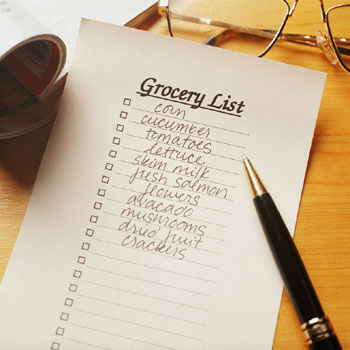 Meal planning does not have to be as daunting as it sounds. Most families and individuals have a discrete rotation of meals and staple foods in their homes. The planning often revolves around dinner. I encourage my clients to identify, or plan, two to three dinners each week. They can think of these on their own, or ask their families or room-mates. Meal planning ensures that everyone is on the same page when it comes time to enjoy the food, but also can save money by preventing last minute stops to the drive-thru.
A bonus of planning is that these “meal plans” are grocery lists with a purpose. We also know that people who shop with a list get in and out of the store more quickly, save money from unplanned for purchases, and typically eat healthier because they do not spend time wondering up and down the snack aisles.
Avoid shopping when you are hungry.
It often does not matter if a person has made a plan and has a grocery list, shopping when you’re hungry takes a lot of discipline. The grocery store can attack all of the five senses if you let it. Don’t take the chance and grab a quick snack before heading into the store.
Shop the perimeter.
You’ve most likely heard this recommendation over-and-over again, but that’s because it’s a good one! We shop with our eyes and it can be difficult to stay away from those tasty (processed) treats. Once our eyes are set on the colorful packaging, our minds can bring back fond memories of the last time we sunk our teeth into that sweet or salty snack. Next thing we know our mouth is watering and we have 2 unaccounted for boxes in our cart.
Buy sale items only if they fit into your menu plan for the week.
Money is a motivator and many often may purchases with food intentions, only to find that BOGO is still in the back of their cabinet. If you have a few spare minutes, sift through the sale papers to help plan your healthy dinners for the week. This way you can save a few bucks and L.B.’s.
Try not to base food choices on price alone; Good nutrition is the goal.
Many believe that eating healthy costs more money. I believe it does not cost more money, but indeed costs more time planning and preparing the food.
In 2011, Americans spent 6.7% of their personal funds at the grocery store. This is the lowest percentage among the 84 surveyed countries in the entire world! Most raw ingredients at the grocery store may appear to cost more initially, but they often create several more servings than their processed counterparts.
Use the Nutrition Facts label and choose one nutrient to focus on each trip.
The nutrition facts label can be the key to a life of moderation. By knowing what to look for and how different foods measure up, an individual can make the best choice every time. I recommend making 4 stops on the label: serving size, saturated fat, sodium and added sugar.
Check out the serving size to ensure that it is reasonable; most people want the most “bang for their buck” meaning the largest portion for a set amount of calories. Next, look at the saturated fat and try to choose products with less than 3 grams per serving, or the product with the least. Sodium is the next stop and it is best to choose foods with less than 300mg sodium (salt) per serving, or less than 150mg if you have hypertension (high blood pressure). The final stop is at added sugar. If the food is processed, meaning it’s not a piece of whole fruit, it is best to keep added sugars to a minimum. Current dietary guidelines recommend that women consume less than 24 grams of added sugar per day and men eat less than 36 grams. Consider these guidelines a bank and spend your sugar grams wisely.
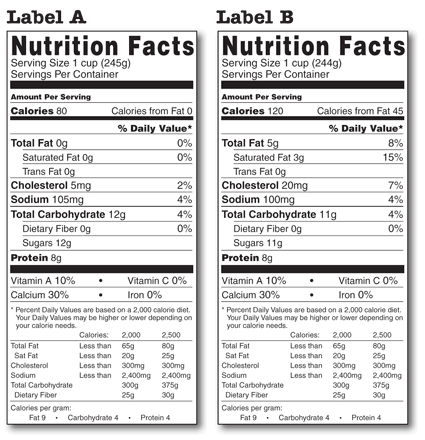
Again, if time is of the essence, choose one nutrient to base your decisions on. If in a time crunch, I recommend basing the decision on saturated fat. This will ensure that the product with the least amount of saturated fat has less “bad,” and may be lower in calories.


Comments
One response to “Supermarket Savvy: Tips to protect your pocketbook and waistline”
[…] health! Plan your menus for the week and use a grocery list. … Here is the original post: Supermarket Savvy: Tips to protect your pocketbook and waistline … ← The Battle Over the […]