
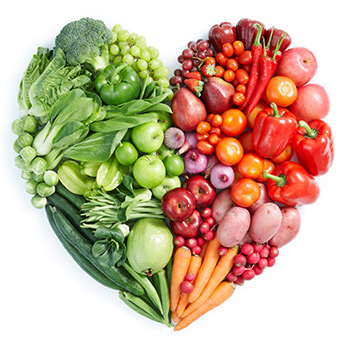
What if the changes women experience in midlife aren’t simply about having “too much” or “too little” estrogen?
That was one of my biggest takeaways from a weekend spent learning about energy, estrogen, metabolism, and women’s health.
I recently attended the Nutridyn Badgerland Wellness Conference, featuring education from Monique Class, MS, APRN-BC, and Dan Lukaczer, ND. The sessions explored a functional medicine approach to menopause and metabolism, including hormone physiology, estrogen metabolism, the gut microbiome, laboratory testing, lifestyle interventions, and the evolving science surrounding menopausal hormone therapy. As a registered dietitian who has spent much of my career working in metabolic health – and who is increasingly integrating Food is Medicine, women’s health, and whole-person care into my work – I left with a lot to think about. Perhaps the biggest lesson was surprisingly simple: Women don’t need another reason to fight their bodies. We need better tools for understanding them.
Estrogen Is About Much More Than Reproduction
We tend to associate estrogen with periods, fertility, and menopause. But estrogen receptors are found throughout the body including the brain, cardiovascular system, bones, metabolic tissues, immune system, muscles, connective tissue, skin, hair, and gut. That helps explain why hormonal transitions can feel so all encompassing. A woman entering perimenopause may notice changes in sleep, mood, body composition, cholesterol, blood sugar or energy, skin, concentration, or exercise tolerance not simply changes in her cycle. Perimenopause itself can last several years (most often a decade), commonly beginning in the 40s but sometimes earlier. And during this transition, ovarian hormone production becomes irregular. Estrogen doesn’t simply march steadily downward often times it feels like a roller coaster and the woman is along for the ride.
Look at the Whole Woman, Not One Hormone
One of my favorite concepts from the weekend was the idea that genetics may influence our tendencies, while our environment and lifestyle can influence many of the pathways involved in health. Food. Movement. Sleep. Stress. Alcohol. Inflammation. Connection. Gut health. Metabolic health. They are interconnected. That’s why we can’t simply ask, “What is your estrogen level?” We must ask:
- How are you sleeping?
- How is your appetite?
- Have your food choices changed?
- How is your digestion?
- Are you moving your body? Are you recovering from that movement?
- What’s happening with blood sugar and insulin?
- What is your stress load?
- And what is your body telling you?
Those questions don’t replace medical care or hormone evaluation. They make the picture more complete so the health care team can work better together to change the noise to a symphony.
Your Body Doesn’t Just Make Estrogen. It Has to Metabolize It.
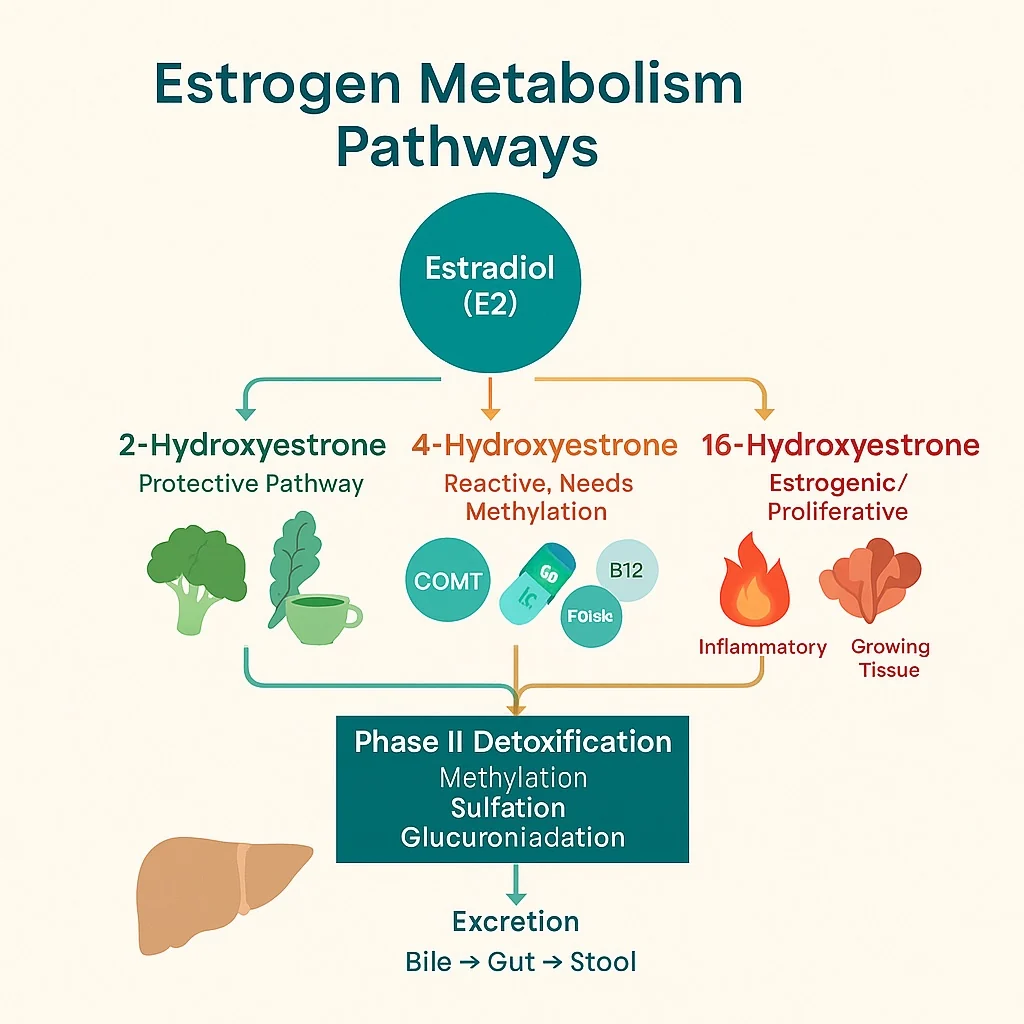
After estrogen has done its job, the body must metabolize and eventually eliminate it. This is a multi-step process with the liver center stage followed by elimination through the kidneys, bile, and intestines. During the first phase of estrogen metabolism, called hydroxylation (addition of an Oxygen and Hydrogen pair), estrogen can be metabolized through three major pathways:
The 2-OH Pathway | Estrogen can be converted into 2-hydroxyestrone (2-OH), primarily through the CYP1A1 enzyme.
This pathway is generally considered the more favorable of the three pathways because 2-OH metabolites tend to have weaker estrogenic activity. These metabolites still need to move through the next stages of metabolism and elimination but functional medicine strategies often focus on supporting metabolism toward this pathway.
The 4-OH Pathway | A second route produces 4-hydroxyestrone (4-OH), primarily through CYP1B1.
These catechol estrogens require efficient Phase 2 metabolism, particularly methylation. If not appropriately metabolized, reactive intermediates can form (ROS), which is one reason this pathway receives attention in research examining oxidative stress and estrogen-sensitive tissues.
The 16-OH Pathway | The third major pathway produces 16-hydroxyestrone (16-OH), associated primarily with CYP3A4 metabolism.
These metabolites have greater estrogenic activity than the 2-OH metabolites. Historically, researchers have investigated the ratio between 2-OH and 16-OH metabolites and its relationship with hormone-sensitive cancers. Here’s an important caveat: these pathways are real biochemistry, but interpreting a woman’s 2-OH, 4-OH, or 16-OH levels as a simple measure of “good” versus “bad” estrogen goes beyond what current clinical evidence can support. Likewise, shifting a metabolite ratio has not been established as a strategy that prevents breast cancer.
That distinction matters to me. Functional nutrition should use emerging science thoughtfully not turn interesting biology into fear.
Can Food Influence Which Estrogen Pathway We Use?
This is where my dietitian brain really lit up. The conference explored how certain foods and nutrients may influence enzymes involved in estrogen metabolism. While a Mediterranean style meal pattern was touted to support overall inflammation, the cruciferous vegetable family was highlighted due to their high glucosinolate content. When these foods like broccoli, brussels sprouts, cabbage, kale and cauliflower are chopped and chewed, glucosinolates can ultimately give rise to bioactive compounds including indole-3-carbinol (I3C), which can form 3,3′-diindolylmethane, or DIM.
DIM has been studied for its ability to influence estrogen metabolism. The conference highlighted research suggesting that DIM can increase CYP1A1 activity more strongly than CYP1B1, potentially favoring formation of 2-hydroxylated estrogen metabolites relative to 4-hydroxylated metabolites. So, translated from biochemistry into real-life advice: Eat your broccoli.
But these cruciferous veggies aren’t working alone. Supporting normal estrogen metabolism means supporting the entire pathway. Adequate protein and amino acids, B vitamins, magnesium, zinc, iron, and sulfur-containing foods provide nutrients involved in normal liver metabolism and clearance. Foods like garlic, onions, leeks, eggs, legumes, fish, poultry and cruciferous vegetables can all contribute. Rather than designing a restrictive “estrogen detox,” I would much rather build a nutrient-dense eating pattern that gives the body the raw materials it needs to do the work it already knows how to do.
Phase 1 Is Only the Beginning
There’s another important piece of this puzzle. Creating a 2-OH estrogen metabolite isn’t the end of estrogen metabolism. The liver still has to process it. During Phase 2, estrogen undergoes processes (including methylation, sulfation, glucuronidation, and glutathione conjugation) to help neutralize metabolites and/or make them easier for the body to eliminate. That requires nutrients, too.
- Methylation depends on nutrients involved in one-carbon metabolism and uses magnesium and zinc as cofactors.
- Sulfation depends on sulfur-containing compounds and nutrients including vitamin B6, magnesium and others.
- Glucuronidation can also be influenced by dietary compounds, including sulforaphane found in cruciferous vegetables.
Then comes something we sometimes forget: The estrogen actually has to leave the body.
Your Gut and Your Hormones Really Do Talk to Each Other
Welcome to one of my favorite rabbit holes: the estrobolome. The estrobolome describes gut bacteria capable of influencing estrogen metabolism. After the liver does its job, some of the estrogen travels through bile into the intestines for elimination. But certain gut bacterial enzymes – namely beta-glucuronidase – can remove that conjugation and reactivate estrogen. Instead of leaving in the stool, some estrogen may then be reabsorbed. Translation? Pooping matters.
Regular bowel movements, adequate fiber (and the right types), hydration, plant diversity, and a healthy gut microbiome aren’t glamorous hormone interventions. But they support the body’s normal elimination processes.
This is why we need to be cautious about aggressively trying to “push” Phase 1 estrogen metabolism with supplements while ignoring constipation, inadequate fiber, or gut dysfunction. We don’t simply want to metabolize estrogen. We ultimately want the metabolites that need elimination to leave the body.
Food Is Information. Food Is Medicine. But It’s Also Just Food.
If all this biochemistry is making your head spin, here’s the beautiful part.
- You don’t need to memorize CYP1A1. You can eat broccoli.
- You don’t need to diagram methylation. You can eat enough protein, vegetables, beans, whole grains, nuts and seeds.
- You don’t need to obsess over your estrobolome. You can eat fiber, drink water, move your body and pay attention to your bowel habits.
Sometimes incredibly complicated physiology leads us back to remarkably simple behaviors.
Energy Matters Just as Much as Estrogen
The speakers repeatedly returned to metabolic flexibility, inflammation, stress, movement, diet, and sleep as modifiable parts of the hormonal picture. This matters because midlife women are often given one message when their bodies begin changing: Eat less. Exercise more. This is much too simple of an equation and often creates more guilt and shame for a person than success.
A woman who is strength training, parenting, working, navigating perimenopause, sleeping six hours, and chronically under-fueling may not need more restriction. She may need more recovery. This may look like…
- More protein.
- Better carbohydrate timing.
- More sleep.
- Strength training rather than endless cardio.
- And enough total energy to maintain muscle, bone, and an active life.
The goal isn’t to make the body smaller. The goal is to help the body remain strong, metabolically healthy, and resilient.
And What About Hormone Replacement Therapy (HRT)?
Nutrition professionals don’t prescribe menopausal hormone therapy, but we should understand the science so we can collaborate with women’s healthcare providers and help patients ask informed questions. One particularly interesting session revisited the Women’s Health Initiative (WHI) – the landmark research that dramatically changed public perception of hormone therapy.
One limitation when applying the original findings to women newly entering menopause is that the average participant was approximately 63 years old, and many women began treatment years after menopause. Subsequent research has created a much more nuanced conversation around who uses hormone therapy, when treatment begins, what formulation and route are used, and an individual’s cardiovascular, breast, bone, and blood-clot risk.
Today, menopausal hormone therapy is not appropriately described as universally “good” or “bad.” It’s an individualized medical decision. And I don’t see this as nutrition versus hormones. For most women, individualized medical treatment and excellent nutrition belong on the same team.
Five Places I Would Start
If you’re somewhere in your 30s, 40s, 50s or beyond and wondering what all of this means for you, don’t start by buying an expensive hormone panel and six supplements. Start with your foundation:
- Eat a diverse, plant-forward diet, including cruciferous vegetables regularly.
- Prioritize protein and strength training to protect muscle and bone as you age.
- Feed your gut with fiber-rich plants and, when tolerated, fermented foods and don’t ignore constipation.
- Protect sleep, recovery, and metabolic health rather than responding to every body change by eating less and exercising more.
- Know your health story. Pay attention to menstrual changes, symptoms, family history, medications, metabolic markers, breast and bone health, and discuss meaningful changes with your healthcare team.
Most importantly, if something feels different, don’t automatically assume you’re “just getting older” and need to tolerate it. Get curious. Your body may be telling you something worth listening to.
“You do not rise to the level of your goals. You fall to the level of your systems.”
– James Clear
Want Help Navigating the Complexities?
As a Registered Dietitian Nutritionist, I use an evidence-informed, whole-health approach to help you connect the dots between your labs, food, gut health, lifestyle and overall health and turn those insights into a realistic plan that works for you.
Your hormone story is more than one number. Food, gut health, and sleep are practical places to start, alongside your healthcare team. If you want help building that foundation, sign up to work with me through Nourish. Employers and teams can find talks on my speaking page.
This article is for educational purposes only and is not intended to diagnose, prevent, or treat disease. Hormone therapy, laboratory testing, and supplementation should be individualized in partnership with appropriately qualified healthcare professionals.
Sources (11)
- Class M, Lukaczer D. A Functional Medicine Approach to Menopause and Metabolism: Estrogen Metabolism and the Microbiome. Badgerland Wellness Conference; 2026. Conference presentation. The presentation describes estrogen metabolism as a three-step process of Phase 1 hydroxylation, Phase 2 conjugation, and Phase 3 elimination.
- Zhu BT, et al. Cancer Research. 1998;58:2269. Yue W, et al. Molecular Pharmacology. 1997;51:951. Huang Z, et al. British Journal of Cancer. 1999;80:1838. Cited in conference materials describing the 2-, 4-, and 16-hydroxylation pathways of estrogen metabolism.
- Meilahn EN, De Stavola B, Allen DS, et al. Do urinary oestrogen metabolites predict breast cancer? Guernsey III cohort follow-up. British Journal of Cancer. 1998;78(9):1250–1255.
- Newman MS, Smeaton J. The impact of 3,3′-diindolylmethane on estradiol and estrogen metabolism in postmenopausal women using a transdermal estradiol patch. Menopause. Published online April 29, 2025. doi:10.1097/GME.0000000000002542.
- Rajoria S, Suriano R, Parmar PS, et al. 3,3′-Diindolylmethane modulates estrogen metabolism in patients with thyroid proliferative disease: a pilot study. Thyroid. 2011;21(3):299–304. doi:10.1089/thy.2010.0245.
- Thomson CA, Ho E, Strom MB. Chemopreventive properties of 3,3′-diindolylmethane in breast cancer: evidence from experimental and human studies. Nutrition Reviews. 2016;74(7):432–443. The conference materials describe DIM as preferentially inducing CYP1A1 relative to CYP1B1 and influencing estrogen hydroxylation.
- Hodges RE, Minich DM. Modulation of metabolic detoxification pathways using foods and food-derived components: a scientific review with clinical application. Journal of Nutrition and Metabolism. 2015;2015:760689.
- Barbosa ACS, Feng Y, Yu C, Huang M, Xie W. Estrogen sulfotransferase in the metabolism of estrogenic drugs and in the pathogenesis of diseases. Expert Opinion on Drug Metabolism & Toxicology. 2019;15(4):329–339.
- Leeming ER, Johnson AJ, Spector TD, Le Roy CI. Effect of diet on the gut microbiota: rethinking intervention duration. Nutrients. 2019;11(12):2862.
- Walaszek Z, Szemraj J, Narog M, et al. Metabolism, uptake, and excretion of a D-glucaric acid salt and its potential use in cancer prevention. Cancer Detection and Prevention. 1997;21(2):178–190.
- Class M, Lukaczer D. Therapeutics for Estrogen Metabolism. Badgerland Wellness Conference; 2026. Conference materials discussed fiber, fermented foods, probiotics, cruciferous vegetables, and calcium-D-glucarate as potential strategies related to estrogen metabolism and beta-glucuronidase.

